

U.S. and EU Reach Tentative Trade Framework, Averting Potential Economic Conflict
In a significant diplomatic breakthrough, President Donald Trump announced that the United States and the European Union have established a preliminary framework for a trade agreement, concluding prolonged discussions with America’s largest trading partner. The announcement came after Trump imposed a 15% tariff on a range of imports from the 27-member EU, including automobiles, pharmaceuticals, and semiconductors, following talks with European Commission President Ursula von der Leyen in Turnberry, Scotland.
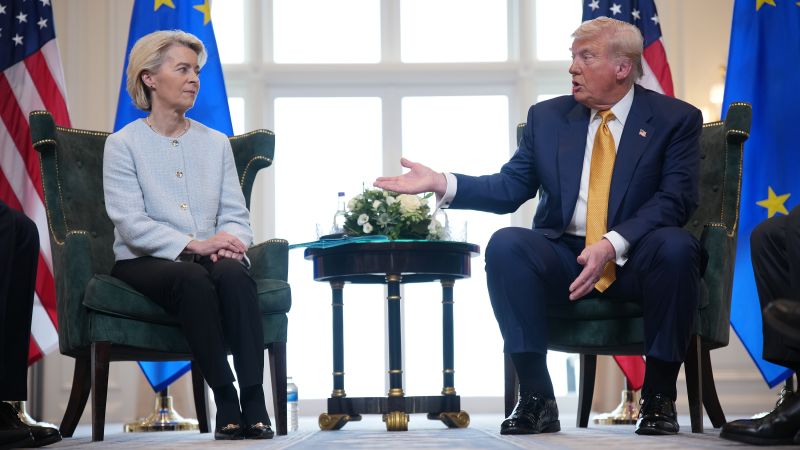
During a joint appearance with von der Leyen at his Scottish golf course, Trump revealed that the EU has committed to purchasing $750 billion in energy from the U.S. and plans to further invest $600 billion in the American economy. He emphasized that all EU countries would engage in tariff-free trade with the U.S. and agreed to acquire substantial military equipment.
While the detailed terms of the deal remain undisclosed, Trump hailed the agreement as the “biggest deal ever made,” a sentiment echoed by von der Leyen, who highlighted the anticipated “stability” and “predictability” it would bring. European leaders broadly welcomed the development, which reduces the looming risk of a transatlantic trade war that could have significant global economic repercussions.
The backdrop to these negotiations was a looming deadline to avert 30% tariffs on European imports, with the EU advocating for maintaining a 10% baseline tariff, while Trump insisted on a minimum 15% rate. Von der Leyen acknowledged the challenging nature of the negotiations, expressing relief at reaching a mutually beneficial conclusion.
Germany’s Chancellor Friedrich Merz praised the hard work of European negotiators, noting the avoidance of a trade conflict that could have severely impacted Germany’s export-driven economy. Italy’s Prime Minister Giorgia Meloni expressed cautious optimism, pending further details, while Ireland’s Prime Minister Micheál Martin regarded the deal as beneficial for businesses, consumers, and investors, despite acknowledging potential challenges under the new tariff regime.
The 15% tariffs encompass pharmaceuticals, the leading category of U.S. imports from the EU, valued at $155 billion last year. Trump had previously suggested the possibility of a 200% tariff on pharmaceuticals manufactured outside the U.S., underscoring the strategic importance of domestic production.
This framework follows Trump’s earlier tariff threats, which included a proposed increase from a 10% baseline to 30%, reflecting one of the “largest trade deficits” between the U.S. and the EU. Previous tariff adjustments saw EU goods face a temporary 20% tariff, with Trump expressing readiness for a 50% tariff in response to stagnant trade talks.
The Friday deadline for other trade partners remains firm, with steel and aluminum tariffs holding steady at 50%. Commerce Secretary Howard Lutnick indicated forthcoming semiconductor tariffs, though their implementation date remains unspecified. Lutnick emphasized the August 1 deadline as definitive, while suggesting potential flexibility for “big economies” in ongoing negotiations.
Amidst these developments, the U.S. is also nearing an August 12 deadline for a trade agreement with China, with tariffs on Chinese goods reduced from 145% to 50%, and reciprocal Chinese tariffs on American goods lowered from 125% to 10%. Treasury Secretary Scott Bessent is scheduled to meet with Chinese officials in Stockholm, aiming to extend the trade truce established in Geneva.
As the meeting with von der Leyen commenced, Trump noted progress with China, hinting at an impending deal while remaining cautious about its outcome. Since pausing “reciprocal” tariffs in April to facilitate trade negotiations, only seven agreements, including the recent EU framework, have been finalized.
