

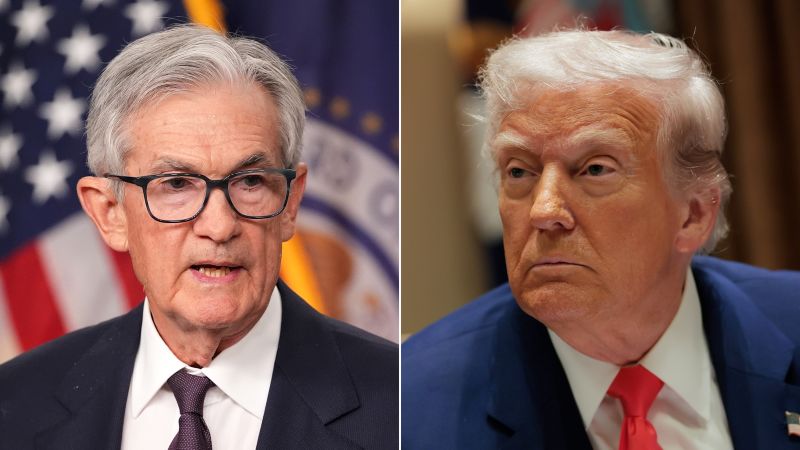
Trump’s push to dismiss Jerome Powell hinges on the belief that lower interest rates could alleviate the nation’s debt burden, yet experts argue that such a move might not deliver the expected relief.
Amidst his efforts to oust Jerome Powell, President Donald Trump has leveled accusations against the Federal Reserve Chair, claiming that the failure to decrease interest rates has cost the nation “hundreds of billions of dollars.” In a handwritten note addressed to Powell and shared on Truth Social, Trump insisted that a significant rate reduction was overdue, emphasizing that substantial financial losses were at stake.
Trump further criticized the Fed board in the same post, asserting that a more diligent performance could have saved the country trillions in interest costs, advocating for an interest rate of 1% or lower. This scrutiny occurs at a time when the escalating interest payments on the federal debt have attracted increased attention.
For the first time in history, the nation’s annual interest payments are approaching $1 trillion. The recent signing of a substantial bill by the president is projected to inflate the deficit by over $3 trillion in the coming decade, potentially driving interest rates even higher. Moody’s recent downgrade of U.S. debt, attributed in part to rising government debt and interest payment ratios, underscores these concerns.
However, experts caution that even if Trump were to compel the Fed to lower rates, the nation’s interest payment burden might not see significant relief. The federal funds rate is merely one component influencing the interest rates on federal debt, which comprises a blend of short-term, medium-term, and long-duration Treasury securities.
According to Shai Akabas, Vice President of Economic Policy at the Bipartisan Policy Center, while altering the federal funds rate may appear as a straightforward mechanism to impact either interest costs on federal debt or economic growth, such actions by the Fed do not guarantee the outcomes desired by the president or others.
It is undeniable that America’s interest costs have surged in recent years, driven by the nation’s expanding debt and the increase in interest rates following a period of exceptionally low rates as the U.S. confronted high inflation earlier in the decade. Interest payments, which amounted to $346 billion in fiscal 2020, are projected to rise to $952 billion this year and are expected to surpass $1 trillion in the near future, according to the Congressional Budget Office.
Interest payments have now become the second-largest expenditure in the federal budget, overtaking Medicare and defense in fiscal year 2024, with only Social Security costing more. Presently, around 18 cents of every tax revenue dollar are allocated to servicing the debt, a figure predicted to increase to about 25 cents by the end of the next decade.
While a reduction in the federal funds rate might lower rates on shorter-term securities, it may not impact the rates on 10-year or 30-year Treasury bonds. In fact, a substantial rate cut could elevate longer-term rates due to potential inflationary pressures or investors shifting to longer-duration securities to secure higher returns, as noted by Marc Goldwein, Senior Policy Director at the Committee for a Responsible Federal Budget.
Goldwein emphasized that the Federal Reserve’s ability to lower these interest rates is limited, and there is no assurance that rate cuts will reduce interest payments. Instead, experts suggest that if Trump genuinely aims to reduce interest payments, he could pursue deficit reduction, which would likely necessitate politically challenging adjustments to taxes and spending.
Although Trump’s agenda includes historic reductions in federal spending on social safety nets, the associated tax cuts significantly exceed the savings, thereby enlarging the annual deficit. Goldwein concluded that for those concerned about the hundreds of billions added to the deficit due to rising interest costs, the solution lies in adopting deficit-reducing policies rather than those that increase it.
