

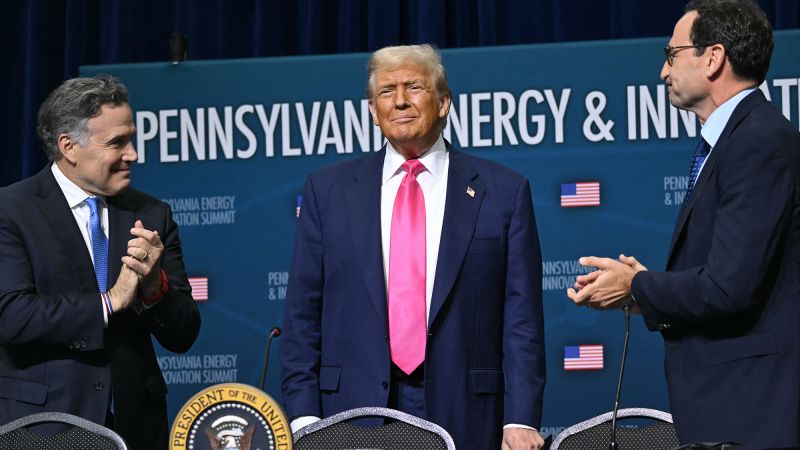
Trump unleashes $90 billion investment to secure America’s AI dominance, leveraging Pennsylvania as a strategic epicenter.
In a significant move to bolster the United States’ position in the global artificial intelligence race, President Donald Trump announced a substantial investment exceeding $90 billion. This funding, sourced from key players in the tech, energy, and finance sectors, aims to establish Pennsylvania as a central hub for AI innovation. The initiative underscores the transformative potential of AI across various sectors, including economics, health care, and education.
The announcement was made during the Pennsylvania Energy and Innovation Summit in Pittsburgh, orchestrated by Senator Dave McCormick. Trump’s administration emphasizes the necessity of maintaining a competitive edge over China, particularly in AI. A critical aspect of this strategy involves ensuring the United States has sufficient energy resources to support AI advancements, a focal point of the summit’s discussions and associated investments.
Central to Trump’s vision for the American economy is the principle of maximizing domestic production throughout every stage of a product’s lifecycle. “With this historic announcement and the commitments being made today, we’re building a future where American workers will forge the steel, produce the energy, build the factories, and really run a country like, I believe, like this country has never been run before,” Trump stated.
Prominent companies such as Anthropic, Blackstone, Brookfield, CoreWeave, Google, Constellation Energy, and Meta are among those investing in the initiative. This effort aligns with China’s increasing focus on expanding its energy resources, especially renewable sources and coal.
The escalating energy demands of AI applications present challenges for tech giants. According to the International Energy Agency, global electricity consumption in data centers is projected to double by 2030, surpassing Japan’s entire electricity usage. Dominion Energy has also revised its energy requirements upwards for the next decade due to rising data center demand, as noted in a 2024 report from JPMorgan.
Blackstone is directing $25 billion towards enhancing data center and energy infrastructure in northeast Pennsylvania, while Google has formed a 20-year partnership with Brookfield to support two state hydropower facilities. Additionally, Meta is investing $2.5 million in a collaborative program with Carnegie Mellon to aid rural Pennsylvania startups.
Anthropic is contributing $1 million over three years to a cybersecurity education initiative for middle and high school students and another $1 million for energy research at Carnegie Mellon.
During the summit, tech, policy, and business leaders expressed concerns about the potential consequences if the United States lags in AI. Anthropic CEO Dario Amodei, who previously warned about AI-induced unemployment spikes, highlighted AI’s significant implications for national security. He stressed the importance of securing every aspect of the supply chain, from chips to AI-building companies, with a particular focus on energy.
Trump has prioritized AI and technological investment throughout his presidency. On his first day in office, he declared a national energy emergency and shortly thereafter introduced a $500 billion AI infrastructure initiative named Stargate, in collaboration with OpenAI CEO Sam Altman, SoftBank CEO Masayoshi Son, and Oracle Chairman Larry Ellison. He also pledged to reverse previous administration’s export restrictions on AI chips.
The competitive tension between the United States and China in AI intensified with Chinese startup DeepSeek’s introduction of its cost-effective yet powerful R1 model. “We’re here today because we believe that America’s destiny is to dominate every industry and be the first in every technology, including being the world’s number one superpower in artificial intelligence,” Trump declared. “And we are way ahead of China. I have to say we’re way ahead of China.”
